- Undergraduate
- Graduate
- Research
- The Stretch
- Inclusivity
- News & Events
- People
Back to Top Nav
Back to Top Nav
Back to Top Nav
Back to Top Nav
Back to Top Nav
This is a shared Earth and Planetary Science laboratory resource, which spans several laboratory facilities that are dedicated to understanding the composition and structure of Earth materials, including waters, soil, and rock. Major instrumentation includes ICP-OES, SEM, and XRD.
Inductively-Coupled Plasma Optical Emission Spectroscopy (ICP-OES) Lab
ICP-OES is a workhorse method for measuring elemental composition of any material that can be solubilized in water or solvent, from fresh rainwater and seawater to soil and rocks digested with strong acid.
Our instrument is a state-of-the-art Spectro ARCOS, operating in both radial and axial plasma views. Routine measurement includes ~20 major/trace elements with typical detection limits of ~1ppb.
The ICP-OES laboratory includes additional resources for sample preparation, including wet digestion of soils/rocks in mixed acid. Other procedures that require filtration, centrifugation, etc. can also be accommodated.
SEM LabScanning electron microscopes (SEMs) are widely used in the geosciences to image objects at high resolution (nanometer- to micrometer-scale) and constrain their elemental compositions. These instruments produce images of samples by scanning the surface with a focused beam of electrons; the electrons interact with atoms in the sample to generate signals (commonly secondary electrons, SEs) that constrain topographic and compositional information. A wide variety of additional detectors can be added to SEMs to provide complimentary compositional information, such as cathodoluminescence (CL), energy-dispersive x-ray spectroscopy (EDS), and electron backscatter diffraction (EBSD).
In Spring 2026, the Department of Earth and Planetary Sciences purchased a new Tescan Vega GMU Variable Pressure Tungsten Filament SEM outfitted with Tescan Al-coated BSE, color CL, and EDS detectors.
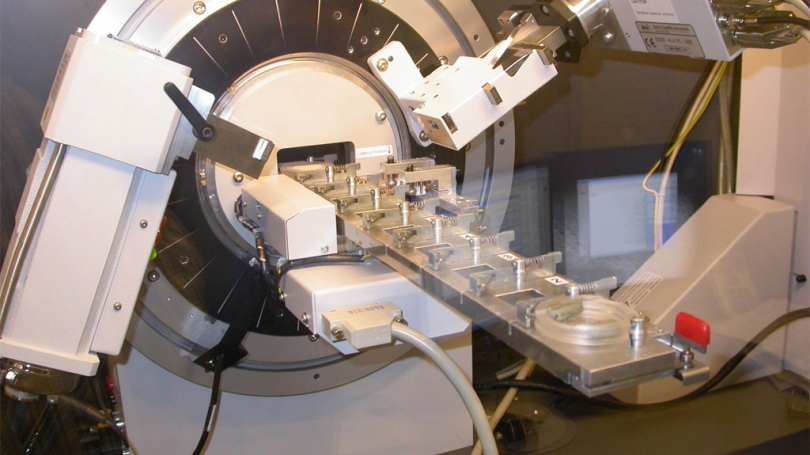
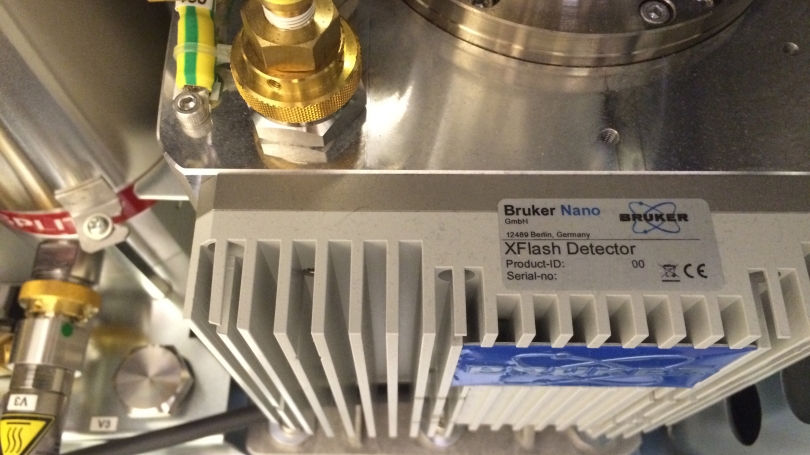
XRD LabX-ray diffraction (XRD) is a critical tool for many Earth and Planetary Scientists. Within the Department, we maintain an XRD laboratory equipped with a Bruker D8-Focus diffractometer. Data analysis is handled by Bruker Eva and Topas software, as well as the PDF database.
This instrument is contained within a dedicated laboratory facility that also has general equipment for the isolation and preparation of mineral suspensions for analysis. In addition to this facility, several other diffractometers, for both powder and single crystal, are available in nearby campus facilities.
Schedule SEM time using our Google Calendar (email Ed Meyer for access to this calendar)